How to Look at Abstract Art Without Guessing
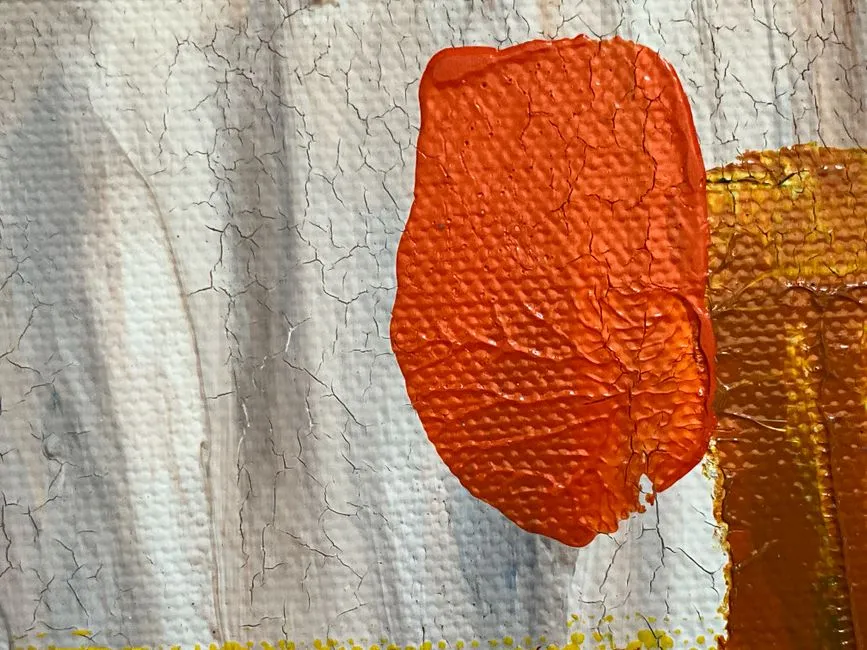
- How do you understand abstract art?
- Start with a working definition
- Separate observation, context, and interpretation
- Make a neutral inventory first
- Look for relationships, not isolated ingredients
- Trace your eye's route
- Try the method on one documented work
- Read the title and label in the right order
- Treat process as evidence, not theatre
- Compare two works to sharpen the reading
- Avoid five common decoding traps
- Use this six-sentence abstract-art note
- Sources
How do you understand abstract art?
To understand abstract art, begin with what the work actually gives you: color, line, shape, space, surface, scale, rhythm, and material. Describe how those elements relate before deciding what they mean. Then add the title, medium, date, artist statement, and museum record. A useful interpretation connects those two layers. It does not treat the painting as a rebus with one secret answer.
This is general art education, not investment advice. A work being abstract, difficult, historically important, or held by a museum does not establish authenticity, provenance, quality, market value, or a future return.
Start with a working definition
The Museum of Modern Art's Modern Art and Ideas guide defines abstract art in its glossary as art generally described as nonrepresentational or not based on external reality or nature. That is a useful starting point, but it is not a command to find nothing recognizable. Work with what is visibly present rather than forcing the picture into an all-or-nothing category.
Abstraction is also not one historical movement or one visual recipe. MoMA's Abstract Generation exhibition text describes abstraction as central to several modern movements and still active in contemporary practice as varied formal languages and ideas. A hard-edged geometric print and a loosely painted field can both be abstract without sharing a method, period, or purpose.
Separate observation, context, and interpretation
Use three columns, whether on paper or in your head:
- Observation: what you can point to in the work.
- Context: what a reliable record establishes about its maker, date, materials, process, or circumstances.
- Interpretation: what you think those observations and facts may do together.
“A dark square sits inside a lighter field” is an observation. “The museum dates the painting to 1963” is context. “The small tonal difference slows my looking” is an interpretation tied to visible evidence. “The artist felt trapped” is not established by the square. It needs a source.
Make a neutral inventory first
Give yourself a minute before reading the wall label. Inventory the work without adjectives such as beautiful, chaotic, calm, childish, or profound. Those words are conclusions wearing name tags.
Record the basics:
- Is the work two-dimensional, three-dimensional, time-based, or spatial?
- What colors dominate, and where do they repeat or break?
- Are lines straight, curved, broken, soft, sharp, thick, or thin?
- Are shapes geometric, organic, open, enclosed, regular, or irregular?
- Where does the work feel dense, and where is there open space?
- Does the surface appear smooth, stained, layered, scraped, glossy, matte, or visibly worked?
- How large is the work in relation to you?
The Getty's formal analysis guide identifies elements including line, shape and form, color, space, texture, and value as parts that can be isolated and defined. This vocabulary is useful because it makes your description checkable. “Three narrow red lines interrupt a gray field” gives another reader something to see. “It has energy” does not yet explain where that energy comes from.
Texture requires care. You can describe an apparent surface without touching it. A painted illusion of roughness and an actually raised surface are different observations, and gallery rules protect both the artwork and the visitor. If the material is unclear, consult the label or staff.
Look for relationships, not isolated ingredients
Once the inventory is complete, ask what the elements do to one another. Color next to another color behaves differently from color alone. A repeated line can create rhythm; one interrupted line can break it. An empty margin can press inward, open outward, or make a central form look unusually small.
Useful relationship questions include:
- What repeats, and what refuses the pattern?
- Where does contrast become strongest?
- Does the composition balance symmetrically, asymmetrically, or not at all?
- Which edge pulls your eye, and where does it send it next?
- Does the work establish a center, distribute attention evenly, or keep shifting it?
- Which parts feel continuous, and which appear cut, covered, erased, or interrupted?
The Getty's companion principles of design guide explains concepts such as emphasis and movement through relationships among size, position, line, edge, shape, and color. You do not need to use every term. Choose the two or three relationships that organize this work most clearly.
Trace your eye's route
Start again at the point that catches you first. Trace where your eye moves next, where it pauses, and whether it returns. Then change your distance if the venue permits. From farther away, large divisions and overall balance may become clearer. From an allowed closer position, edges, layers, and variations may become more visible.
Do not turn that route into a universal law. Another viewer may begin elsewhere, and a reproduction may flatten scale, surface, or subtle color. State the conditions honestly: “From the doorway, I noticed the diagonal first” is stronger than “The diagonal is always the first thing viewers see.”
Time matters even when the object does not move. A work can disclose differences slowly because your eyes adjust, your attention settles, or repeated looking changes what you notice.
Try the method on one documented work
MoMA's collection record for Ad Reinhardt's Abstract Painting provides a tidy test. The museum identifies it as a 1963 oil painting. Its text says the canvas may initially look monochromatically black, while careful or prolonged looking reveals a three-by-three grid and different shades of black.
An observation-first reading might proceed like this:
- First glance: a dark square field with little obvious contrast.
- Longer look: a grid begins to appear through tonal difference.
- Relationship: the divisions depend on near-similarity rather than loud contrast.
- Effect: recognition arrives gradually, so duration becomes part of the viewing experience.
- Context: the museum record confirms the grid, materials, date, and tonal distinctions.
The effect sentence is an interpretation, not a quotation from the artist. It remains accountable because the preceding observations show how it was reached. You could form a different reading from the same evidence. What you cannot responsibly do is invent a private event in Reinhardt's life and announce that the grid symbolizes it.
Read the title and label in the right order
Looking before reading prevents the label from doing all the seeing for you. Reading afterward prevents your first impression from becoming a private empire.
Start with the medium line. “Oil on canvas,” “screenprint,” “found materials,” and “digital print” name different processes and limits. Then check the date, dimensions, and whether the work belongs to a series. Read the curatorial text for documented context, but distinguish its claims from the artist's own words. If a quotation appears, note who said it and where it came from.
A title can redirect attention, but it need not decode the image. A descriptive title may name a color, place, number, or compositional feature. An evocative title may open an association rather than settle it. “Untitled” is still a title supplied in the record; it is not permission to attach any biography you please.
If the label conflicts with what you think you see, keep both facts visible. Lighting, reproduction, restoration, viewing distance, and your own perception can affect an encounter. Ask a question before declaring the record wrong.
Treat process as evidence, not theatre
Marks can suggest actions: a drip, repeated stroke, crisp masked edge, transferred image, scraped layer, or erased line. Describe the mark first. Use “appears” when the process is not documented.
Do not reverse-engineer a studio performance from the finished surface. A smooth area might result from several methods; a gestural mark does not prove it was made quickly or emotionally. Museum technical notes, conservation records, artist interviews, and reliable catalogues can establish process. Your guess cannot.
This distinction also keeps craft questions honest. Visible brushwork is not automatically more skilled than a flat surface, and geometric precision is not automatically mechanical. “How was this made?” is a research question, not a ranking system.
Compare two works to sharpen the reading
When one work feels mute, put it beside another in your mind or in the gallery. Compare one variable at a time:
- dense color against restricted color;
- soft edges against hard edges;
- repeated modules against irregular marks;
- visible layering against an even surface;
- centralized composition against all-over distribution;
- intimate scale against architectural scale.
Then write one sentence with a “whereas”: “The first work concentrates contrast at the center, whereas the second distributes small contrasts across the surface.” That sentence does more work than deciding which one is more advanced, expressive, expensive, or important.
For the historical distinction between a modern movement and work made in the present, use our guide to contemporary versus modern art. It will keep “modern,” “contemporary,” and “abstract” from becoming one large, unhelpful bucket.
Avoid five common decoding traps
- The hidden-object hunt: recognizable shapes can matter, but not every curve is a secret face.
- The mood shortcut: “sad” or “joyful” is a beginning. Point to the color, spacing, scale, rhythm, or memory that produced the response.
- The biography invention: an artist's life may provide context only when a reliable source connects it to the work.
- The difficulty ranking: immediate legibility and artistic quality are different questions. So are personal preference and historical importance.
- The single-answer demand: interpretations can differ, but they are not equally supported. Evidence decides which readings deserve more confidence.
Use this six-sentence abstract-art note
Finish your visit with six sentences:
- The work consists of...
- My eye first goes to...
- The strongest relationship is between...
- The surface or process appears to...
- The label establishes...
- From that evidence, I read the work as...
Underline every interpretation in sentence six, then draw a line back to the observation or source supporting it. Any phrase left floating is not forbidden; it is simply a question for another look.
Abstract art does not require you to guess what the artist was thinking. It asks you to notice what is present, learn what can be documented, and build an interpretation sturdy enough to show its joints.