What Is Sound Art? Listen to Space, Time, and Source
- The short answer
- What makes a work sound art?
- Why does the room matter so much?
- How should you listen to sound art?
- Listen for source, transformation, and destination
- Is sound art different from music?
- What if a sound work is quiet, inaudible, or partly visual?
- Protect your hearing and follow the venue
- A five-question reading card
- Sources
The short answer
Sound art is art in which sound, listening, or the conditions of hearing are central to the work. It may use recordings, voices, instruments, loudspeakers, vibrations, architecture, live transmission, or sounds already present in a place. The point is not simply that audio accompanies an object. Sound helps organize the work's meaning, space, duration, or the audience's behavior.
That definition stays deliberately roomy. MoMA describes sound art as a complex field approached through visual art, architecture, performance, computer programming, and music. A useful first question is therefore not “Does this count?” but “What has the artist asked sound to do?”
What makes a work sound art?
Sound art treats sound as material. Paint can be spread, layered, scraped, or allowed to reveal a surface; sound can be placed, repeated, filtered, transmitted, amplified, delayed, or made dependent on where a listener stands. MoMA used that material analogy when discussing the artists in its 2013 exhibition Soundings: A Contemporary Score.
Listen for four jobs sound may perform:
- It defines space. A sound changes as you approach a speaker, enter another room, turn your head, or encounter an echo.
- It unfolds in time. You cannot receive a duration all at once. Arrival, repetition, interruption, and waiting become part of the work.
- It identifies or obscures a source. You may hear a voice without seeing a body, machinery without seeing a machine, or a field recording far from where it was made.
- It makes listening visible as an action. The work may reveal how attention, memory, expectation, and position affect what seems to be there.
Some sound works include drawings, sculpture, video, text, or performance. Some are silent until activated. MoMA's account of Soundings even includes visualizations of otherwise inaudible sound. Sound art is not a promise of continuous audio; it is a way of making sound and listening structurally important.
Why does the room matter so much?
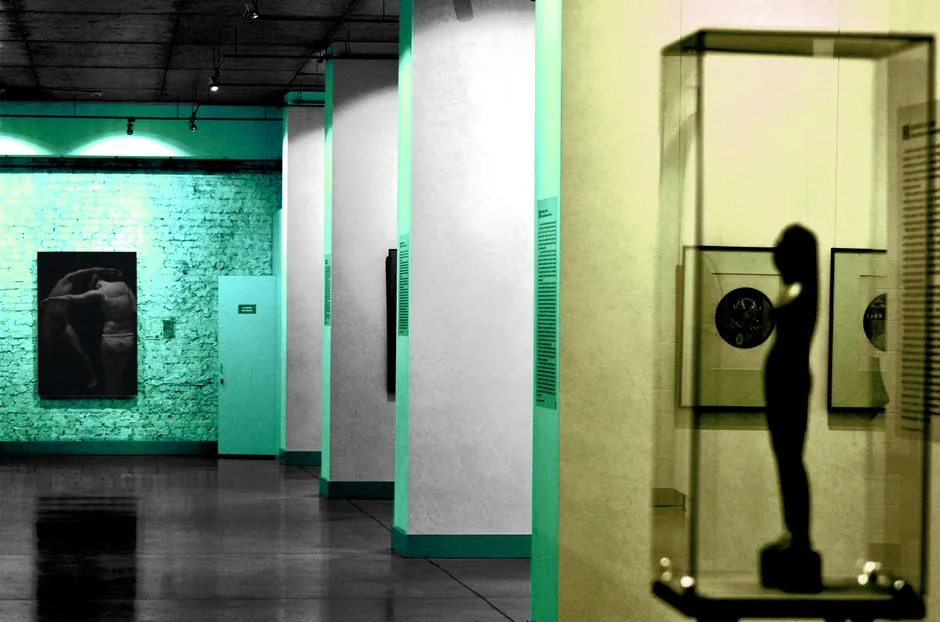
Sound does not stay politely inside its frame. It travels, overlaps, reflects, fades, and arrives from beyond the viewer's line of sight. The room is therefore not neutral packaging. Walls, openings, surfaces, neighboring works, visitor movement, and speaker placement can all shape the encounter.
SFMOMA's essay “Exhibiting Sound” describes sound in a museum as something that can spread into an aural environment and overlap with other acoustic layers. The same essay presents sound as sculpture, immersive installation, an act of listening, and acoustic tracks in space. Those are not four competing definitions. They are four ways a work can make the gallery do more than hold equipment.
Consider Bill Fontana's Sonic Shadows (2010). SFMOMA describes the site-specific installation as using vibration sensors and moving speakers to reveal resonances in the museum building. Sounds from structural elements and visitors' footfalls entered a live composition. The building was not a container for a finished soundtrack; it was one of the work's sources.
This is why a quick recording on a phone may document a sound work without reproducing it. A recording can preserve audio, but not necessarily the original scale, direction, movement, room response, or relationship between body and source.
How should you listen to sound art?
Begin with a small survey before hunting for a grand interpretation.
- Find the source, if there is a visible one. Note speakers, instruments, objects, performers, headphones, transducers, screens, or openings into another space.
- Notice what changes with position. Move only where the venue permits. Compare the edge, center, doorway, and any marked listening point.
- Give it a full pattern. Stay long enough to discover whether the work loops, accumulates, responds, pauses, or changes unpredictably. Do not assume the first sound is the whole piece.
- Separate recorded sound from live sound. Ask whether the work plays a fixed file, receives a transmission, generates sound from current data, amplifies the room, or combines several systems.
- Read the label after a first listen, then listen again. The label may identify a source or process that changes what you notice without dictating what you must feel.
Your path can become a mixing tool. The Metropolitan Museum of Art describes Janet Cardiff's The Forty Part Motet as an installation of forty speakers arranged in a large oval. Each speaker carries a distinct vocal part, so a listener hears different balances by walking among them. The composition matters, but so do distance, direction, and the listener's decision to stand near one voice or between many.
Listen for source, transformation, and destination
A practical way to read a sound work is to follow three stages.
Source: What began the sound? It might be a voice, a place, an object, an electromagnetic field, an archive, a live action, or a software process. If the source is concealed, that concealment may be deliberate rather than a puzzle with one correct answer.
Transformation: What happened between source and listener? Recording, editing, repetition, amplification, translation, spatial distribution, and filtering all make choices audible. Even an apparently untouched field recording has a microphone position, start, stop, and playback setting.
Destination: Where and how does the sound meet the audience? Headphones create a different relationship from a shared room. One loudspeaker establishes a different field from a ring of speakers. A sound that follows movement makes the audience's path part of the work.
Jacob Kirkegaard's AION (2006) makes this chain unusually clear. MoMA's account explains that Kirkegaard recorded abandoned spaces in the Chernobyl Exclusion Zone, played each recording back into its room, and recorded the result again in repeated layers. The source is a place, the transformation is recursive playback and recording, and the destination is a sound-and-video installation. The process does not merely illustrate the buildings. It changes how their apparent silence is perceived.
Is sound art different from music?
Sometimes yes, sometimes not cleanly. A song presented in a gallery does not automatically stop being music, and a sound installation can use harmony, rhythm, performers, or a score without surrendering its place in visual-art discourse. Institutions themselves acknowledge the overlap: MoMA's Soundings brought together artists approaching sound through music, visual art, architecture, performance, and computing.
The more useful distinction is about the terms of attention. Music is often organized for listening as a composition or performance. Sound art may make the listening situation equally important: the architecture, route, technology, source, social setting, or act of attention can be part of the work rather than support around it.
That “may” matters. Sound art is not music minus melody, nor is it every unusual noise installed beside a label. Look at how the work is framed, what the artist and presenting institution say it is doing, and what would be lost if its sound or listening conditions disappeared. Categories can overlap without becoming meaningless.
If the neighboring labels—modern, contemporary, installation, performance, conceptual—are beginning to crowd the room, the difference between modern and contemporary art provides a useful chronological reset. “Sound art” names an approach or medium, not a period with one agreed start and finish.
What if a sound work is quiet, inaudible, or partly visual?
Listening does not always mean receiving an audible sequence through the ears. A work may translate sound into an image, expose a signal outside ordinary hearing, use captions or notation, or focus on the politics of who is heard. It may also make silence, absence, vibration, and expectation part of the encounter.
Do not treat the visual part as a consolation prize. Read captions, transcripts, diagrams, scores, and installation notes as components with their own roles. Ask the venue what access materials or alternative formats are available rather than assuming every sound-based work offers the same access route. If a work depends on movement, check whether there is a stationary or seated way to experience its changes.
This broader view is consistent with MoMA's description of artists treating sound as material even when their work is not always audible. The category is held together by inquiry into sound and listening, not by a minimum quantity of noise.
Protect your hearing and follow the venue
Read and follow posted sound warnings, staff instructions, capacity limits, and marked routes before entering an installation. Do not stand closer to a speaker or sound-producing mechanism than the venue permits. If the sound is uncomfortable, painful, or produces ringing, leave the space and move away from the source. Do not remain in place to complete an artwork.
The National Institute on Deafness and Other Communication Disorders advises avoiding loud sounds, moving away, turning down the volume where possible, and using properly fitted hearing protection when loud exposure cannot be avoided. Its hearing-protector guidance also notes that loud sound can damage inner-ear structures. This article does not assign a decibel level or safe exposure time to any installation; the venue must assess its own equipment and conditions.
Ask staff before using personal hearing protection if doing so could conflict with an installation's safety instructions or prevent you from hearing alarms and directions. Children need supervision in spaces with speakers, cables, moving parts, darkened paths, or restricted areas. These are physical gallery conditions, not interpretive challenges.
A five-question reading card
When the sound stops—or when you decide it never really did—write down five answers:
- What produced the sound or signal?
- How was it transformed before it reached me?
- What changed when I moved or waited?
- Which parts belonged to this room, this audience, or this moment?
- What would disappear if the sound or listening condition were removed?
Those questions work whether the piece resembles sculpture, composition, broadcast, archive, performance, or weather with a power cable. They also keep interpretation attached to evidence. Sound art can be elusive; the encounter need not be vague.
If a sound work is being considered for purchase, ask separately about equipment, files, installation instructions, replacement policy, artist-approved display conditions, rights, and conservation support. That is general educational guidance, not investment advice, and the work's format does not predict value or resale.